
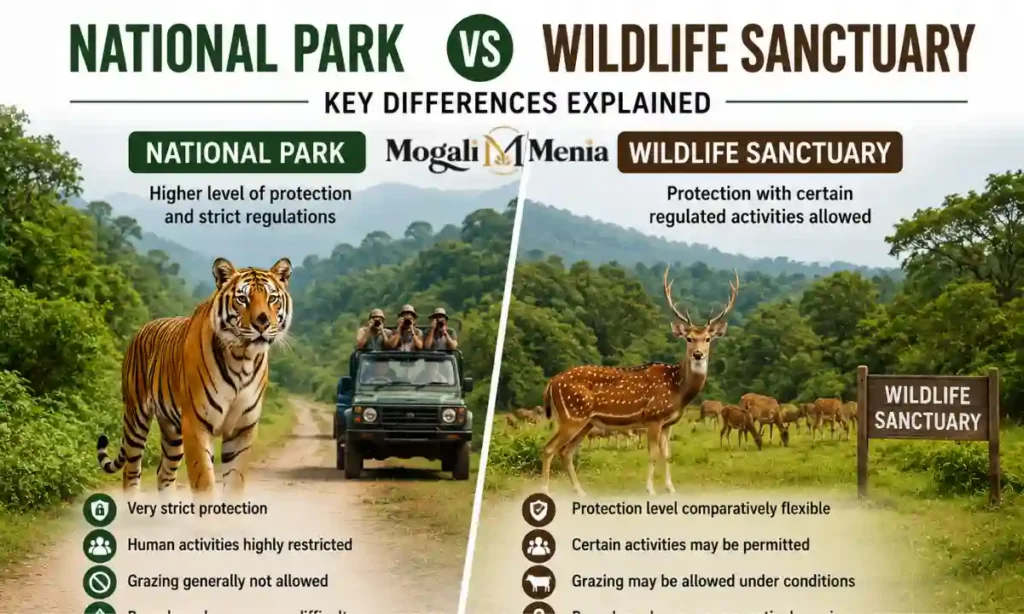
National Parks and Wildlife Sanctuaries form part of the Protected Areas in India. They both serve the same purpose of conserving wildlife, flora, fauna, forests, biodiversity, and habitat, though they are different. What makes a National Park and a Wildlife Sanctuary different is the fact that they have different degree of legal protection, human activity that can take place in each, approach towards management and dealing with rights. Wildlife Sanctuary usually has some regulated human activity that takes place within its boundaries, while a National Park has a more conservative approach.
Difference Between National Park and Wildlife Sanctuary
Wildlife Sanctuary is an area of land created specifically for the protection and preservation of wild animals, birds, plants, and their habitats. Certain human activities are allowed in some Wildlife Sanctuaries depending on their legal status and conservation regulations.
National Park, on the other hand, is a much stricter form of protecting wildlife, biodiversity, ecosystems, and landscapes from any human interference. There are fewer human activities allowed in such areas in order to protect the natural environment.
Difference between Wildlife Sanctuary and National Park can be determined by their approaches to protection. While Wildlife Sanctuary allows some human activities, National Park tries to preserve its protected environment in more restricted way.
National Park vs Wildlife Sanctuary
| Basis of Difference | Wildlife Sanctuary | National Park |
|---|---|---|
| Main Objective | Protection of wildlife and their habitats | Protection of entire ecosystems, wildlife and landscapes |
| Protection Level | High level of protection | Generally stricter protection |
| Human Activities | Certain regulated activities may be permitted | Human activities are highly restricted |
| Grazing | May be allowed under specific conditions or recognised rights | Generally prohibited |
| Existing Rights | Certain rights may be recognised and regulated | Rights are settled through the statutory process |
| Boundary Changes | Follow the applicable statutory procedure | More stringent procedure applies |
| Conservation Approach | Wildlife and habitat-focused | Ecosystem and biodiversity-focused |
| Tourism | Regulated tourism may be allowed | Regulated tourism may be allowed |
| Resource Use | Limited and regulated | More strictly restricted |
| Legal Framework | Wild Life (Protection) Act, 1972 | Wild Life (Protection) Act, 1972 |
What Is a Wildlife Sanctuary?
A Wildlife Sanctuary is a protected area meant for conservation of wildlife and their habitats. It creates an environment where wildlife is able to thrive, breed and exist naturally. Wildlife sanctuaries may be used for conservation of individual or multiple species of wildlife, forests, wetlands, grassland and other important ecosystems. The importance of wildlife sanctuaries is not restricted to a particular species of wildlife. One key characteristic of wildlife sanctuaries is that some activities can be carried out as per the law within these sanctuaries. Such activities vary from one sanctuary to another.
Key Characteristics of Wildlife Sanctuaries
- Conservation of wildlife and their habitats.
- Conservation of threatened and endangered species.
- Prevent hunting and poaching.
- Protection of important forests and ecosystems.
- Conservation of biodiversity.
- Ecological study.
- Nature tourism under regulation.
- May include some recognized rights.
- Wildlife corridors and habitats.
- Conserve environment and educate people about it.
What Is a National Park?
National Park refers to an area that is recognized under law for the protection of flora and fauna, biodiversity, ecosystems, landscapes, and natural ecological processes. In terms of regulation, National Parks tend to be more strict than Wildlife Sanctuaries. Grazing, hunting, mining and other activities that involve human interference are not permitted. This is not done merely for the purpose of protecting individual animals. The aim here is to preserve the ecosystem as a whole in which natural components co-exist.
Difference in Level of Protection
Protection level is perhaps one of the most distinguishing features among the two. The National Parks come with stricter protection regulations. Actions which might disturb the animals or harm the natural environment are highly controlled. The Wildlife Sanctuaries offer equally strong protection but have a slightly more flexible legal protection system allowing some recognized activities.
Thus, simply stated:
- National Park = Strict Protection
- Wildlife Sanctuary = Strong Protection with more room for activities
Difference in Human Activities
There is more restriction on human activity in case of National Parks. Human activities such as grazing, resource collection, building and other forms of interference are regulated by law. In case of Wildlife Sanctuaries, some activities are permitted by law or by the authorities. This does not, however, mean that Wildlife Sanctuaries are open areas where natural resources can be utilized by people. The main concern in such areas is wildlife conservation.
Difference in Grazing
Another area that distinguishes between the two is grazing. Grazing within National Parks is prohibited. The legal system allows for very few exceptions under very strict conditions. In case of Wildlife Sanctuaries, some grazing rights may be considered, depending on the legal provision.
This can be summarized as follows:
- National Park: Grazing is prohibited.
- Wildlife Sanctuary: Some grazing rights may be considered.
Difference in Existing Rights
The treatment of existing rights differs between National Parks and Wildlife Sanctuaries. During the process of establishing a National Park, claims and rights over the proposed area are dealt with through the statutory settlement process.
Wildlife Sanctuaries also involve investigation and settlement of rights, but the legal framework can allow certain recognised rights to continue under specified conditions. This difference is particularly important in areas where local communities have historically depended on surrounding natural resources.
Difference in Rules Regarding Change in Boundaries
The two categories are also different based on the rules regarding change in their boundaries. There is much legal protection afforded to the boundaries of National Parks. It means that any change has to go through a much stricter statutory process. It is the same with the Wildlife Sanctuary boundary where the change has to follow a certain process; however, this process is different from that of National Parks.
Difference in Conservation Goal
The conservation goals of the two categories have some differences, even though they are overlapping.
Wildlife Sanctuary
It focuses on the conservation of the animals along with their habitats. Some sanctuaries might be of greater importance to particular animals depending on the areas.
National Park
It has a wider scope and usually includes conservation of ecosystems, biodiversity and natural ecological processes. Therefore, National Parks involve conservation of an entire ecosystem.
Difference in Area and Coverage
However, there is no hard and fast rule that every National Park should necessarily be bigger than every Wildlife Sanctuary. But National Parks usually consist of huge expanses of land where there are forests, grasslands, mountains, swamps or any other kind of ecosystem. Wildlife Sanctuaries can also be very big. Thus, it cannot be said that the size differentiates a National Park from a Wildlife Sanctuary.
Difference in Tourism
Both National Parks and Wildlife Sanctuaries have tourism activities, though the conditions of each activity might differ from one another. Generally, National Parks have higher standards of tourism that ensure minimal impact to the wildlife in terms of disruption. Visits might be confined to set safari trails, paths and particular zones only, while off-road touring, noise and unauthorized constructions are forbidden. On the other hand, Wildlife Sanctuaries can provide more leeway in terms of tourism based on their respective plans for management and regulation.
Difference in Ownership and Control
Protected areas of India are based on government notifications and laws. There is no truth to the assumption that all Wildlife Sanctuaries are privately owned and all National Parks have the exact same form of management. Ownership and management will vary from one protected area to another, depending on its individual laws. What makes them different is the fact that both types of areas are protected by law for wildlife conservation.
Difference in Legal Status
Both National Parks and Wildlife Sanctuaries are included within the provisions of the Wild Life (Protection) Act of 1972. However, there are some differences in relation to the provisions of these two types of areas. The legal regime governing National Parks is more stringent in respect of activities, rights, and boundaries.
National Park vs Wildlife Sanctuary: Simple Explanation
The distinction between the two can be better explained with an example. Assume there are two forests which require protection. One of the forests is made into a National Park where human intervention remains highly limited so as to preserve the ecosystem. In the case of the other forest, it is designated as a Wildlife Sanctuary where wildlife is given complete protection but some legal rights or activities are still allowed.
Thus,
- National Park = Protection + Fewer Activities
- Wildlife Sanctuary = Protection + More Activities
- It should be noted that this is a general explanation, since actual distinctions will vary from case to case.
Wildlife Sanctuary and National Park Facts
First National Park of India
The first national park of India came up in 1936 and it was originally named Hailey National Park. Later on, it became Jim Corbett National Park.
Hemis National Park
Hemis National Park in the Ladakh region is renowned because of the high altitude area and its snow leopards.
Kaziranga National Park
Kaziranga in the state of Assam is well-known due to the presence of Indian one-horned rhinoceroses.
Gir National Park
The Gir National Park in Gujarat is renowned for housing Asiatic lions and this park holds great significance for these lions.
Wildlife Sanctuaries
India has many wildlife sanctuaries which include various kinds of ecosystems like forests, deserts, coastal and mountainous areas etc.
Significance of Conservation
Both types of protected areas play an important role in biodiversity conservation, wildlife recovery, habitat protection and environment education.
Importance of Wildlife Sanctuaries
Wildlife Sanctuaries constitute significant protected places that facilitate secure living for various species like animals, birds, reptiles, etc. These sanctuaries not only aid in the conservation of biological diversity but also prevent threats from hunting, poaching, habitat degradation, and human interference.
Additionally, Wildlife Sanctuaries play a significant role in protecting various vulnerable and endangered species. They offer suitable environment for feeding, breeding and migration along with protection to forests, wetlands, grasslands and other vital habitats. Furthermore, many sanctuaries promote various activities related to scientific research, wildlife management and education about the environment.
Moreover, Wildlife Sanctuaries aid in generating sustainable tourism that offers a chance to people to get closer to nature without causing any disturbance to wildlife. Also, tourism activities generate employment for local communities along with conservation efforts. Therefore, it is evident that Wildlife Sanctuaries are vital for the preservation of India’s natural heritage.
Importance of National Parks
National Parks have an essential function in conserving ecosystems on a larger scale.
They assist with:
- Conservation of natural ecosystems.
- Protection of wildlife that is endangered.
- Conservation of forests and vegetation.
- Biodiversity.
- Natural landscape protection.
- Ecological research.
- Environmental education.
- Promotion of sustainable tourism.
- Habitat conservation.
- Ecological process conservation.
National Park vs Wildlife Sanctuary: Which Has More Protection?
A National Park generally has more stringent protective measures compared to a Wildlife Sanctuary. The fact does not suggest that the latter does not offer sufficient protection for the wildlife. Both are legally established zones that provide substantial protection for the wildlife and their habitat. The key difference lies in the level of compatibility with regulated human activities and rights.
National Park vs Wildlife Sanctuary Table
| Feature | National Park | Wildlife Sanctuary |
| Protection | Very strict | Strict |
| Wildlife conservation | Yes | Yes |
| Habitat protection | Yes | Yes |
| Human interference | Highly restricted | Regulated |
| Grazing | Generally prohibited | May be allowed under recognised rights |
| Existing rights | Settled through legal process | Investigated and settled |
| Boundary changes | More stringent | Different statutory procedure |
| Tourism | Regulated | Regulated |
| Wildlife viewing | Possible | Possible |
| Trekking | May be permitted in designated areas | May be permitted in designated areas |
| Birdwatching | Possible | Possible |
| Commercial development | Highly controlled | Highly controlled |
Examples of National Parks in India
The following National Parks are some popular examples from India:
- Jim Corbett National Park
- Kaziranga National Park
- Kanha National Park
- Bandhavgarh National Park
- Ranthambore National Park
- Gir National Park
- Pench National Park
- Sundarbans National Park
- Periyar National Park
- Great Himalayan National Park
- Nagarhole National Park
- Bandipur National Park
National Park vs Wildlife Sanctuary: Which Is Better for Wildlife?
Both have great worth when it comes to wildlife. A National Park can be especially helpful in the conservation of an entire ecosystem while keeping the presence of humans at a bare minimum. A Wildlife Sanctuary can be especially helpful where there is a need for conservation but there are some human rights which have been recognized as well.
Examples of Wildlife Sanctuaries in India
Some of the famous Wildlife Sanctuaries are:
- Ralamandal Wildlife Sanctuary
- Wayanad Wildlife Sanctuary
- Chinnar Wildlife Sanctuary
- Bhadra Wildlife Sanctuary
- Dandeli Wildlife Sanctuary
- Indian Wild Ass Sanctuary
- Kutch Desert Wildlife Sanctuary
- Ranganathittu Bird Sanctuary
- Point Calimere Wildlife and Bird Sanctuary
National Park vs Wildlife Sanctuary: Easy Way to Remember
The differences between the two can be memorized with the help of a simple equation:
National Park = Ecosystem + more protection + less human intervention
Wildlife Sanctuary = Wildlife + habitat + human activities regulated
This is just a basic concept of how to differentiate the two. Exact conditions may vary depending upon the notification of the protected area.
FAQs
What is the main difference between a National Park and a Wildlife Sanctuary?
The main difference is the degree of legal protection and the extent of human activities permitted. National Parks generally have stricter restrictions, while Wildlife Sanctuaries can accommodate certain recognised or regulated activities.
Which has stricter protection?
National Parks generally have a stricter protection framework than Wildlife Sanctuaries.
Can grazing take place in a Wildlife Sanctuary?
Certain recognised or regulated grazing rights may exist in a Wildlife Sanctuary depending on its legal and management provisions.
Is grazing allowed in a National Park?
Grazing is generally prohibited inside National Parks, subject to specific legal exceptions.
Can humans live inside a Wildlife Sanctuary?
The answer depends on the particular sanctuary and the rights that have been legally recognised and settled.
Can humans live inside a National Park?
Existing claims and rights are addressed through the statutory settlement process before the final declaration of a National Park.
Are National Parks open to tourists?
Yes. Many National Parks permit regulated tourism through designated routes, safari zones and other authorised activities.
Are Wildlife Sanctuaries open to tourists?
Yes. Many Wildlife Sanctuaries permit regulated tourism, birdwatching, safaris and nature activities.
Are both governed by the same law?
Both are primarily governed by India’s Wild Life (Protection) Act, 1972, although different provisions apply to National Parks and Wildlife Sanctuaries.
Which is larger, a National Park or Wildlife Sanctuary?
There is no absolute size rule. Many National Parks are large, but some Wildlife Sanctuaries are also extensive. Size alone does not determine their legal category.
Conclusion
Difference Between National Park and Wildlife Sanctuary exists primarily on the basis of their legal protection, conservation policy, and the level of activities that can take place inside the area. National Park usually gives better protection to whole ecosystems, biodiversity, and natural scenery, whereas Wildlife Sanctuary gives protection to wildlife and habitats while permitting some recognised or controlled activities under certain conditions. These both are equally important for the conservation efforts in India. Collectively, they help in conserving forests, animals, birds, flora and fauna, ecosystems, and natural scenery.
Also Read About: Ralamandal Wildlife Sanctuary, Timings, Entry Fee & Guide