
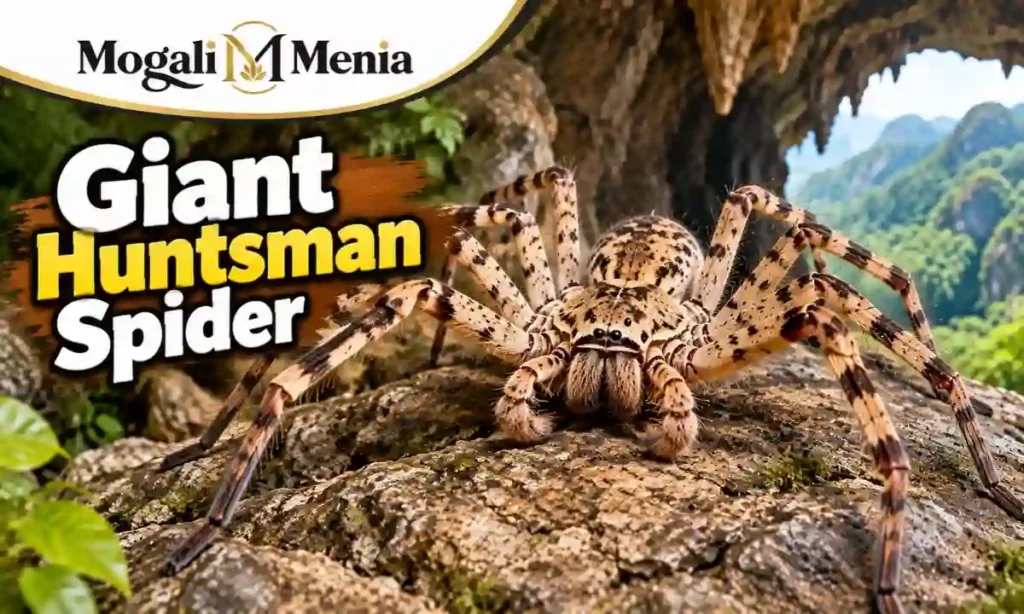
Giant Huntsman Spider is one of the most remarkable spiders in the world and is famous for having an enormous leg span compared with its body. Scientifically known as Heteropoda maxima, this species belongs to the huntsman spider family Sparassidae and was scientifically described from Laos in 2001. It is particularly famous because its legs can spread to around 30 centimetres, making it the largest known spider by leg span.
Unlike web-building spiders that wait for prey to become trapped, huntsman spiders actively search for and chase their prey. Their long, sideways-oriented legs give them a distinctive crab-like appearance and allow them to move rapidly across rocks and other surfaces. The giant huntsman is associated with cave environments in Laos and remains an elusive species that is rarely encountered.
Although its appearance can be intimidating, the Giant Huntsman Spider is not considered a major danger to humans. Its large size is mainly a result of its extremely long legs rather than an exceptionally heavy body. This distinction is important because the Goliath birdeater is generally regarded as the heavier spider, while the giant huntsman holds the remarkable leg-span record.
What Is a Giant Huntsman Spider?
Giant Huntsman Spider is a large predatory arachnid belonging to the genus Heteropoda. Its accepted scientific name is Heteropoda maxima Jäger, 2001, and the World Spider Catalog currently lists Laos as its known distribution.
The species is characterised by its flattened body and extremely long legs. Like other huntsman spiders, its legs extend sideways from the body rather than being held primarily underneath it. This structure gives the spider its characteristic crab-like appearance and helps it move quickly while hunting.
Giant Huntsman Spider Quick Facts
| Feature | Details |
|---|---|
| Common Name | Giant Huntsman Spider |
| Scientific Name | Heteropoda maxima |
| Family | Sparassidae |
| Genus | Heteropoda |
| Order | Araneae |
| Known Distribution | Laos |
| Discovery / Description | Scientifically described in 2001 |
| Maximum Leg Span | About 30 cm |
| Body Length | Around 4.6 cm reported |
| Main Habitat | Caves and associated forest environments |
| Feeding Behaviour | Active predator |
| Web Building | Does not rely on a prey-catching web |
| Diet | Mainly insects and other small arthropods |
| Venom | Venomous for prey immobilisation |
| Human Danger | Generally considered low |
How Big Is the Giant Huntsman Spider?
The size of the Giant Huntsman Spider is what made it internationally famous. Its maximum recorded leg span is 30 centimetres, or about one foot across. Guinness World Records recognises Heteropoda maxima for the largest recorded arachnid leg span.
However, its body is considerably shorter than its total leg span. Reports place its body length at roughly 4.6 centimetres. Therefore, when people describe this spider as being nearly a foot wide, they are referring to the distance between the tips of its widely spread legs, not the length of its body.
| Measurement | Size |
|---|---|
| Maximum Leg Span | 30 cm |
| Maximum Leg Span in Inches | About 11.8 inches |
| Body Length | About 4.6 cm |
| Body Length in Inches | About 1.8 inches |
Is the Giant Huntsman Spider the Biggest Spider in the World?
The answer depends on how spider size is measured. The Giant Huntsman Spider is generally recognised as the largest known spider by leg span, reaching approximately 30 centimetres.
It is not, however, the heaviest spider. The Goliath birdeater, Theraphosa blondi, is generally regarded as the largest spider by mass. This comparison shows why the phrase “largest spider” needs to be qualified when discussing different spider records.
| Spider | Notable Record |
|---|---|
| Giant Huntsman Spider | Largest known by leg span |
| Goliath Birdeater | Largest known by mass |
| Giant Huntsman | Up to about 30 cm leg span |
| Goliath Birdeater | Heavier-bodied tarantula |
Where Does the Giant Huntsman Spider Live?
The Giant Huntsman Spider is known from Laos in Southeast Asia. The World Spider Catalog currently lists Laos as its distribution, while scientific literature links the species with cave habitats.
The species was famously discovered in a cave in Laos. Its association with caves and other difficult-to-explore environments may help explain why such a remarkably large spider remained unknown to science until the early 21st century.
Giant Huntsman Spider Habitat
Caves appear to be particularly important to the known habitat of Heteropoda maxima. These environments provide darkness, shelter and access to a variety of small animals that can serve as prey.
The wider environment around caves can also include forest and rocky habitats. Because the species is rarely observed, scientists still have much to learn about its complete ecology and population distribution.
Discovery of the Giant Huntsman Spider
The species was formally described by arachnologist Peter Jäger in 2001. The scientific description appeared in Zoosystema and identified Heteropoda maxima as a new species from Laos. Its discovery attracted considerable attention because of its exceptional size. Finding such a large spider in a cave highlighted how much biodiversity can remain hidden in poorly explored environments.
Physical Appearance
The Giant Huntsman Spider has the flattened body typical of huntsman spiders, combined with exceptionally long legs. Its coloration is generally yellowish-brown with darker markings, helping it blend into rocky and cave environments.
The legs are particularly distinctive. They are long, laterally oriented and marked with darker bands in parts. This structure gives the spider its unusual crab-like appearance.
| Physical Characteristic | Description |
|---|---|
| Body Shape | Flattened |
| Main Colour | Yellowish-brown |
| Markings | Darker irregular patterns |
| Legs | Extremely long and laterally positioned |
| Appearance | Crab-like |
| Eyes | Eight eyes |
| Body Length | Around 4.6 cm |
| Maximum Leg Span | Around 30 cm |
Why Does It Look Like a Crab?
Huntsman spiders are sometimes called giant crab spiders because of the way their legs are positioned. Instead of extending predominantly downward from the body, their legs are angled sideways. This arrangement allows them to move quickly across surfaces and squeeze into spaces. In the Giant Huntsman, the effect is especially dramatic because of the extraordinary length of its legs.
How Does the Giant Huntsman Spider Move?
The Giant Huntsman Spider is known for its speed and active hunting behaviour. Instead of waiting passively for insects to become trapped in a web, it searches for prey and pursues it.
Its long legs give it a wide stride and allow rapid movement across cave surfaces. Huntsman spiders are also capable of moving across vertical surfaces, making them effective predators in complex environments.
Does the Giant Huntsman Spider Build a Web?
The Giant Huntsman does not depend on a conventional prey-catching web. Like other huntsman spiders, it is primarily an active hunter. It uses speed, sensory information and venom to capture prey rather than constructing a large sticky web and waiting for insects to become trapped. This hunting strategy is one of the defining characteristics of the huntsman group.
Also Read About: Kawal Wildlife Sanctuary, Wildlife, Safari & Travel Guide
What Does the Giant Huntsman Spider Eat?
The Giant Huntsman Spider is a predator that feeds on smaller animals, particularly insects and other arthropods. Its active hunting behaviour allows it to search for prey around caves and surrounding habitats.
The exact diet of this rarely observed species is not as well documented as that of more common huntsman spiders. However, its anatomy and hunting behaviour are consistent with a predator adapted to capturing relatively small animals.
How Does It Hunt?
The Giant Huntsman Spider uses its excellent movement abilities and sensory systems to locate prey. Once a suitable target is detected, it can move rapidly towards it. After catching prey with its legs and mouthparts, the spider uses venom to immobilise the animal. The prey is then consumed by the spider.
Is the Giant Huntsman Spider Venomous?
Yes, the Giant Huntsman Spider produces venom, as spiders generally use venom to subdue prey. However, venomous does not automatically mean highly dangerous to humans. Available descriptions indicate that huntsman spider bites can cause local pain and swelling, but the Giant Huntsman is not regarded as a medically significant spider comparable to species known for severe envenomation.
Is the Giant Huntsman Spider Dangerous to Humans?
Despite its frightening appearance, the Giant Huntsman Spider is generally considered to pose a relatively low risk to humans. Like many spiders, it is more likely to avoid a large animal than deliberately attack it. A bite could occur if the spider is trapped, handled or seriously threatened, so wild individuals should always be left alone.
Does the Giant Huntsman Spider Bite?
It can bite, but bites are considered uncommon. Huntsman spiders are primarily interested in catching prey rather than attacking humans. If a large spider is encountered in the wild, the safest approach is to avoid touching it and give it enough space to move away.
Giant Huntsman Spider vs Goliath Birdeater
The Giant Huntsman Spider and Goliath birdeater are both famous for their enormous size, but they achieve that size in very different ways.
The Giant Huntsman has the greater known leg span, while the Goliath birdeater is much heavier and more robust. The huntsman is a fast-running spider with long, sideways-oriented legs, whereas the Goliath birdeater is a massive tarantula with a much heavier body.
| Feature | Giant Huntsman | Goliath Birdeater |
|---|---|---|
| Scientific Name | Heteropoda maxima | Theraphosa blondi |
| Family | Sparassidae | Theraphosidae |
| Main Size Record | Leg span | Body mass |
| Maximum Leg Span | About 30 cm | About 28 cm reported |
| Body Type | Flattened and slender | Heavy and robust |
| Hunting Style | Active hunter | Mostly ground-dwelling predator |
| Web Use | Does not use prey-catching webs | Does not rely on prey-catching webs |
| Distribution | Laos | Northern South America |
Giant Huntsman Spider vs Other Huntsman Spiders
The Giant Huntsman belongs to a large family containing many species of different sizes. Most huntsman spiders are large compared with ordinary household spiders, but Heteropoda maxima is exceptional because of its extreme leg span. Its 30-centimetre span is significantly larger than the dimensions typically associated with many other huntsman species.
Why Is the Giant Huntsman So Large?
The exact evolutionary reasons for the Giant Huntsman’s exceptional size are still an interesting subject for research. Its cave-associated lifestyle and long-legged body structure may be connected to the environments in which it evolved. Large legs can provide advantages for rapid movement and navigating complex rocky surfaces. However, scientists cannot attribute its unusual size to one simple cause without further ecological and evolutionary evidence.
Reproduction
Like other spiders, the Giant Huntsman reproduces sexually. Male huntsman spiders use specialised structures called pedipalps to transfer sperm to females. Detailed information about the reproduction and life cycle of Heteropoda maxima is limited because the species is rarely observed in the wild. Much of the scientific understanding of huntsman reproduction comes from related species.
Conservation and Population
The Giant Huntsman is an unusual example of a species that became famous shortly after its scientific description. Because it is associated with caves and appears to have a restricted known distribution, its habitat deserves careful protection. Its exact conservation status should not be confused with its popularity. The World Spider Catalog confirms its taxonomic identity and distribution, but the available sources do not establish a simple population estimate for the species.
Threats to the Giant Huntsman Spider
Cave ecosystems can be vulnerable to human disturbance. Tourism, habitat modification, uncontrolled collecting and changes to surrounding forests can potentially affect cave-dwelling organisms. The discovery of Heteropoda maxima also generated significant public and collector interest. The Senckenberg Nature Museum notes that uncontrolled collecting following the spider’s fame contributed to the disappearance of the species from some easily accessible caves.
Importance of Cave Conservation
Caves are home to many specialised organisms that cannot easily survive outside their natural environment. Protecting caves therefore means protecting an entire underground ecosystem rather than just one species. Maintaining natural cave conditions, limiting unnecessary disturbance and preventing uncontrolled wildlife collection can help preserve rare cave-dwelling species such as the Giant Huntsman Spider.
Giant Huntsman Spider in Laos
Laos is the only country currently listed as the distribution of Heteropoda maxima in the World Spider Catalog. The country’s extensive limestone landscapes and cave systems provide habitat for numerous specialised organisms. The discovery of such a remarkable spider in Laos demonstrates the biological importance of these environments.
Why Was It Discovered So Recently?
It would be surprising for some people to think about the existence of a spider almost one foot in size being discovered only in 2001. However, Giant Huntsman spiders are found mainly in caves, and not all caves have been well researched yet. The location of some caves is difficult to access as well.
Is the Giant Huntsman Spider Rare?
The Giant Huntsman might indeed be rare in terms of sighting frequency; however, rarity does not necessarily indicate exact population sizes. Its geographical distribution is limited only to Laos in the World Spider Catalogue, and since the Giant Huntsman is a cave dweller, studying it is rather challenging. Further investigations are required to shed some light on the exact population sizes and distribution of the species.
Interesting Facts About Giant Huntsman Spider
| No. | Interesting Fact |
|---|---|
| 1 | Its scientific name is Heteropoda maxima. |
| 2 | It belongs to the huntsman spider family Sparassidae. |
| 3 | It was scientifically described in 2001. |
| 4 | It is known from Laos. |
| 5 | Its maximum leg span can reach about 30 cm. |
| 6 | It is recognised for the largest known spider leg span. |
| 7 | Its body is much shorter than its total leg span. |
| 8 | It is associated with cave habitats. |
| 9 | It actively hunts rather than relying on a prey-catching web. |
| 10 | Its legs give it a distinctive crab-like appearance. |
| 11 | It uses venom to immobilise prey. |
| 12 | It is not considered one of the world’s medically most dangerous spiders. |
| 13 | It is smaller in body mass than the famous Goliath birdeater. |
| 14 | Its discovery attracted international attention because of its unusual size. |
| 15 | Cave conservation is important for protecting its specialised habitat. |
FAQs
What is the Giant Huntsman Spider?
The Giant Huntsman Spider is a large huntsman spider scientifically known as Heteropoda maxima. It belongs to the family Sparassidae and is known from Laos.
How big is the Giant Huntsman Spider?
Its leg span can reach 30 centimetres, while its body is much shorter, around 4.6 centimetres in reported measurements.
Is the Giant Huntsman Spider the biggest spider?
It is generally recognised as the largest known spider by leg span, reaching around 30 centimetres. The Goliath birdeater is heavier and is generally considered the largest spider by mass.
Where is the Giant Huntsman Spider found?
The World Spider Catalog currently lists Laos as its known distribution.
When was the Giant Huntsman Spider discovered?
It was scientifically described as a new species by Peter Jäger in 2001 after specimens were found in Laos.
Does the Giant Huntsman Spider spin webs?
It does not rely on a conventional prey-catching web. Huntsman spiders actively pursue prey instead.
What does the Giant Huntsman Spider eat?
It is a predator that feeds on insects and other small arthropods.
Is the Giant Huntsman Spider poisonous?
It is venomous in the biological sense because it uses venom to immobilise prey. However, its venom is not generally regarded as highly dangerous to humans.
Can the Giant Huntsman Spider bite humans?
Yes, it can bite if threatened or handled, but it generally avoids humans. A bite may cause local pain and swelling.
Why does the Giant Huntsman Spider look like a crab?
Its long legs are oriented sideways, giving it a crab-like appearance. This is a characteristic feature of huntsman spiders.
Conclusion
Giant Huntsman Spider belongs to the group of the most incredible creatures within the class of Arachnida. Due to its impressive leg span measuring up to 30 cm, Heteropoda maxima can be regarded as the biggest known spider in terms of leg span length. In fact, the size, flattened body shape, and crab-like legs make it instantly recognizable among all other huntsman spiders.
The spider is found in Laos and lives in caves. Therefore, this example proves that there still are many unknown species that can be found in nature. Moreover, since this spider is active and does not build webs waiting for the food to fall in, it is significantly different from the usual spiders.
Despite its frightening appearance, the Giant Huntsman Spider is not a dangerous creature for humans. Its main value consists in its special biology, impressive size and being part of a specialized cave ecosystem. The preservation of natural cave ecosystems and prevention of uncontrolled collection are the main methods of protecting the creature.
Also Read About: Blind Snake, Habitat, Diet, Types, Facts & Characteristics