
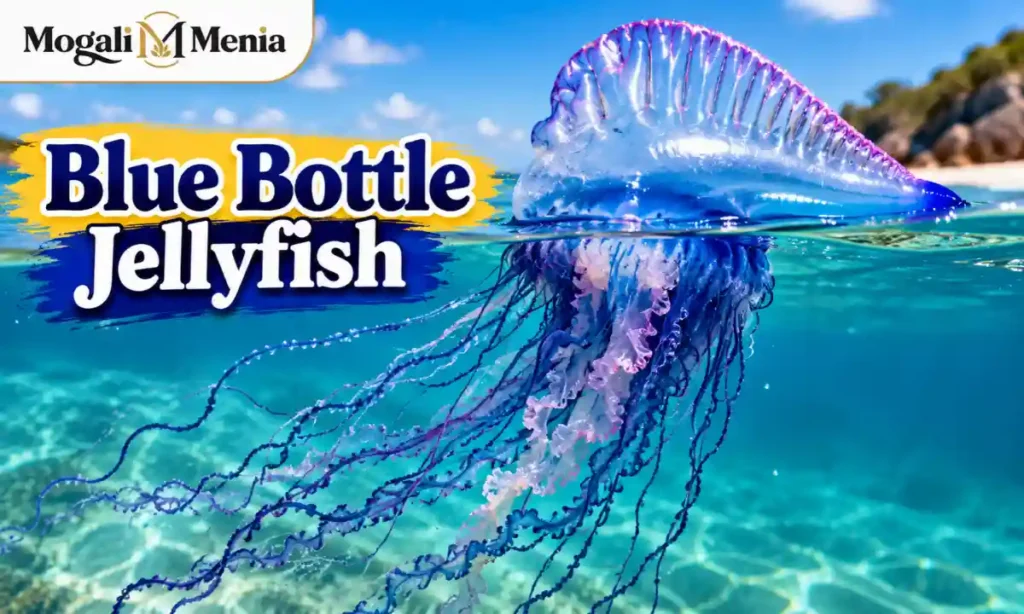
Blue Bottle Jellyfish is one of the most distinctive floating marine creatures found in warm and temperate oceans. Its bright blue, bottle-shaped float and long trailing tentacles make it easy to recognize, especially when groups are washed onto beaches by strong winds and ocean currents. Although it is commonly called a jellyfish, the blue bottle is actually a colonial siphonophore, made up of specialized organisms that work together as one colony.
The creature is both beautiful and fascinating, but its tentacles can deliver a painful sting. Blue bottles use their specialized stinging cells to capture small marine animals and defend themselves. Their unusual body structure, wind-driven movement, feeding method and ability to survive as a coordinated colony make them an important and interesting part of marine ecosystems.
What Is a Blue Bottle Jellyfish?
Blue Bottle Jellyfish belongs to the genus Physalia and is a member of the phylum Cnidaria, the same broad animal group that includes corals and sea anemones. It is not a true jellyfish because its body is not one individual animal.
Instead, a blue bottle is a colony made up of highly specialized units known as zooids. Each type of zooid performs a particular function, such as floating, catching food, digesting prey or reproduction. Together, these specialized parts allow the colony to survive as a single functioning organism.
Blue Bottle Jellyfish Quick Facts
| Feature | Details |
| Common Name | Blue Bottle |
| Scientific Group | Physalia |
| Family | Physaliidae |
| Class | Siphonophora |
| Phylum | Cnidaria |
| Type | Colonial marine organism |
| Main Colour | Blue, green and sometimes pink |
| Float Size | Can exceed 15 cm |
| Habitat | Surface waters of oceans |
| Main Food | Larval fish, molluscs and small crustaceans |
| Movement | Wind and ocean currents |
| Main Defence | Stinging cells |
| Common Name in Some Regions | Pacific Man-of-War |
| Main Distribution | Indian and Pacific Oceans |
Why Is It Called a Blue Bottle?
The name Blue Bottle comes from its distinctive floating structure. The upper part of the colony looks somewhat like a small bottle or inflated sac and is usually blue in colour.
This structure is known as the pneumatophore. It contains gas and keeps the colony at the surface of the sea. The float also works like a sail, allowing wind to influence the direction in which the colony travels. Depending on the individual and lighting conditions, the float may show blue, green or pinkish shades along its upper edge.
Is the Blue Bottle Jellyfish a Real Jellyfish?
No. Despite its popular name, the blue bottle is not a true jellyfish. A blue bottle is a colonial siphonophore consisting of several specialized zooids. These zooids are dependent on one another and perform different functions within the colony.
Some specialized parts are responsible for capturing prey, others digest food, while reproductive zooids help produce the next generation. The gas-filled float is also a specialized member of the colony.
Blue Bottle Jellyfish Appearance
The most recognizable feature of the blue bottle is its elongated, blue-coloured float. It can appear translucent when sunlight passes through it and may develop subtle green or pink shades.
Long tentacles extend beneath the float and trail through the surrounding seawater. These tentacles may be extremely difficult to see, particularly when the water is cloudy or when the blue bottle is floating some distance away. The tentacles contain microscopic structures called nematocysts. These specialized stinging cells help the blue bottle capture prey and protect the colony from potential threats.
Blue Bottle Jellyfish Habitat
Blue bottles live primarily in marine surface waters. They are particularly associated with the Indian and Pacific Oceans, while the related Portuguese Man-of-War occurs in the Atlantic and other regions.
They are strongly influenced by environmental conditions because they cannot swim like fish. Wind and surface currents carry them across the ocean.
Along parts of Australia’s coastline, blue bottles are especially noticeable during particular seasons when favourable winds and currents push them toward exposed beaches.
Where Are Blue Bottle Jellyfish Found?
Blue bottles can be found in different parts of the Indian and Pacific Oceans. They are particularly well known along the Australian coastline.
On Australia’s eastern coast, they are commonly encountered during warmer months. In southern Western Australia, they are more frequently observed during cooler seasons. They are generally more common on exposed beaches than in sheltered coastal areas because strong onshore winds can carry them toward land.
How Does a Blue Bottle Jellyfish Move?
Unlike fish and many actively swimming marine animals, a blue bottle does not have the ability to swim from one location to another. Instead, its gas-filled float acts like a Natural sail. Wind pushes the float across the water while ocean currents also influence its movement.
Interestingly, blue bottles can have different orientations of their sail-like crest. Some tend to move in one direction relative to the wind, while others move in the opposite direction. This variation may reduce the chances of an entire population being carried onto the same beach.
Blue Bottle Jellyfish Tentacles
The tentacles are among the most important structures in the blue bottle colony. They are responsible for detecting and capturing prey.
As the blue bottle moves across the ocean surface, its tentacles trail beneath the float. Small marine organisms that come into contact with them can be captured by the colony’s stinging cells. The tentacles then help bring the captured prey toward specialized digestive zooids.
What Does a Blue Bottle Jellyfish Eat?
Blue bottles are carnivorous marine predators. They mainly feed on small organisms living near the ocean surface.
Their diet can include:
| Food | Description |
| Larval Fish | Tiny developing fish |
| Copepods | Small planktonic crustaceans |
| Amphipods | Small marine crustaceans |
| Molluscs | Small soft-bodied marine animals |
| Surface Plankton | Tiny organisms drifting in seawater |
| Other Small Marine Animals | Opportunistic prey |
How Does the Blue Bottle Catch Its Food?
The blue bottle uses specialized stinging cells called nematocysts to capture prey. These microscopic structures contain coiled threads that can rapidly discharge when stimulated.
When a small animal touches the tentacles, the nematocysts fire and help immobilize the prey. The captured animal is then transported toward the colony’s digestive structures. This feeding system allows the blue bottle to hunt without actively chasing its prey.
What Are Nematocysts?
Nematocysts are specialized microscopic structures found in cnidarians. They function as tiny biological weapons used for prey capture and defence.
When stimulated, a nematocyst can rapidly release a thread that penetrates or attaches to the target. Venom is then delivered through the structure. In blue bottles, these stinging cells are especially important because the colony depends on its tentacles to capture food while drifting through surface waters.
Is a Blue Bottle Jellyfish Dangerous?
A blue bottle can deliver a painful sting, but typical bluebottle stings are generally not considered among the most dangerous jellyfish-related injuries.
The severity can vary between individuals. A sting may cause immediate pain, redness and distinctive marks where the tentacles contacted the skin. In uncommon cases, more serious symptoms can occur. Children, older people, people with allergies and anyone experiencing severe symptoms should receive appropriate medical attention.
What Does a Blue Bottle Jellyfish Sting Feel Like?
A blue bottle sting can cause sudden and intense pain at the point of contact. The affected area may become red and can develop lines or marks corresponding to the tentacles.
Pain may continue for an hour or longer in some cases, while skin markings can remain for several days. The severity depends on factors such as the amount of tentacle contact, the individual’s sensitivity and the area of skin affected.
Blue Bottle Jellyfish Sting First Aid
If someone is stung by a blue bottle, the general first-aid approach is to avoid rubbing the affected area and carefully remove visible tentacles using appropriate methods.
For bluebottle stings in non-tropical Australian waters, recommended first aid includes rinsing the area with seawater and placing the affected area in hot water at a tolerable temperature for around 20 minutes. Fresh water and vinegar are not recommended for typical bluebottle stings because they may increase pain or trigger additional stinging.
Anyone experiencing severe symptoms, breathing difficulty, widespread or persistent symptoms, or a sting involving the face or throat should seek urgent medical assistance.
Can a Blue Bottle Jellyfish Sting After It Washes Ashore?
Yes. A blue bottle that has washed onto the beach should never be touched with bare hands. Even when the creature appears dead, its tentacles may still contain functioning stinging cells. A person can therefore receive a painful sting by picking up a stranded blue bottle. Beachgoers should keep children and pets away from them and follow local beach safety instructions.
Why Do Blue Bottle Jellyfish Wash Up on Beaches?
Blue bottles are transported by wind and ocean currents. When winds blow toward the coast, floating colonies can be carried into shallow water.
Strong onshore winds can sometimes bring large numbers of blue bottles onto exposed beaches at the same time. This explains why a beach that had no visible blue bottles one day may suddenly have hundreds or even thousands scattered along the shoreline after changing weather conditions.
Blue Bottle Jellyfish Life Cycle
The life cycle of a blue bottle is quite different from that of many familiar jellyfish. Blue bottles are hermaphroditic, meaning reproductive structures within the colony contain male and female components. After fertilization, the developing organism passes through a planktonic stage.
The young stage eventually develops into a new colony through a process involving asexual budding. The resulting colony develops specialized structures for floating, feeding, defence and reproduction.
Blue Bottle Jellyfish Reproduction
Reproduction is handled by specialized zooids known as gonozooids. These reproductive structures produce the cells required for sexual reproduction. Once fertilization takes place, development continues through microscopic stages before a new colony is formed.
The division of reproductive duties among different zooids is one of the features that makes siphonophores so unusual in the animal kingdom.
Also Read About: Giant Huntsman Spider, Size, Habitat, Diet & Facts
Blue Bottle Jellyfish and the Ocean Ecosystem
Blue bottles are an important component of marine food webs. They consume small organisms near the ocean surface and can also become food for specialized marine predators.
Their presence demonstrates how drifting organisms contribute to energy movement through marine ecosystems. Although they can be an unwelcome sight for swimmers, blue bottles are natural members of the ocean environment and play a role in maintaining ecological relationships.
Blue Bottle Jellyfish Predators
Blue bottles are not completely safe from predators. Certain marine animals have developed specialized ways of feeding on floating cnidarians.
One interesting example is the violet sea snail, which can feed on floating cnidarians. Another remarkable animal is the blue sea slug, which is known for feeding on blue bottle tentacles and can retain their stinging structures for its own defence. These relationships demonstrate the complex interactions that exist among drifting marine organisms.
Blue Bottle Jellyfish vs True Jellyfish
| Feature | Blue Bottle | True Jellyfish |
| Biological Group | Siphonophore | Medusozoan jellyfish |
| Body Structure | Colony | Generally one animal |
| Gas-Filled Float | Present | Usually absent |
| Movement | Wind and currents | Many species actively swim |
| Specialized Zooids | Present | Not organized in this way |
| Tentacles | Present | Present in many species |
| Stinging Cells | Present | Common in cnidarians |
| Surface Lifestyle | Very common | Depends on species |
Blue Bottle vs Portuguese Man-of-War
The names Blue Bottle and Portuguese Man-of-War are sometimes used interchangeably, although regional usage can differ.
Blue bottles found around Australia are commonly associated with Physalia species such as Physalia utriculus. The Portuguese Man-of-War is generally associated with Physalia physalis. Both belong to the siphonophore group and share the characteristic gas-filled float and long stinging tentacles.
Blue Bottle Jellyfish Size
The visible float of a blue bottle can reach more than 15 centimetres in length. However, the overall animal can appear much larger because of its long trailing tentacles. The tentacles extend beneath the surface and may be difficult to see. Their length and transparency make it difficult for swimmers to determine how close they are to the stinging structures.
Interesting Facts About Blue Bottle Jellyfish
- The Blue Bottle Jellyfish is actually a colonial siphonophore.
- It belongs to the phylum Cnidaria.
- Its scientific group is Physalia.
- Its blue float is filled with gas.
- The float works like a natural sail.
- Wind and ocean currents control much of its movement.
- Different zooids perform different functions.
- Its tentacles contain microscopic nematocysts.
- It feeds mainly on small marine organisms.
- Larval fish and tiny crustaceans are among its prey.
- Blue bottles can wash ashore in large groups.
- A stranded blue bottle can still sting.
- It is not a true jellyfish.
- Some marine predators feed on blue bottles.
- Blue bottles are important members of surface marine ecosystems.
Blue Bottle Jellyfish on the Beach
Finding blue bottles on a beach is usually connected to weather and ocean conditions rather than a permanent change in the local marine environment.
A strong onshore wind can push floating colonies toward land. When this happens, they may appear along large stretches of coastline. People should avoid touching them, even when the blue float has dried out. It is also sensible to check local beach warnings before entering the water when large numbers have been reported.
Are Blue Bottle Jellyfish Common?
Blue bottles can be locally common during favourable conditions, particularly along exposed Australian beaches. Their numbers can vary considerably from one location and season to another because their distribution depends heavily on wind, currents and ocean temperatures.
A sudden appearance of many blue bottles does not necessarily mean they have permanently increased in number. Weather conditions may simply have concentrated floating colonies along a particular coastline.
Why Is the Blue Bottle Jellyfish Important?
The Blue Bottle Jellyfish is important because it represents an unusual form of marine life in which multiple specialized organisms cooperate as one functioning colony.
Its gas-filled float allows it to remain at the ocean surface, while specialized tentacles capture prey and other zooids handle digestion and reproduction.
Studying blue bottles also helps scientists understand the complexity of marine food webs and the remarkable adaptations that allow organisms to survive in constantly moving ocean environments.
What Should You Do If You See a Blue Bottle?
If you see a blue bottle floating in the water, avoid it and give it plenty of space. If one has washed onto the beach, do not touch it. When several blue bottles are present, it is safer to follow lifeguard and beach-warning instructions before entering the water.
Keeping children and pets away from stranded blue bottles is particularly important because their bright appearance can make them look harmless.
FAQs
Is a Blue Bottle Jellyfish actually a jellyfish?
No. It is a colonial siphonophore belonging to the genus Physalia rather than a true jellyfish.
Are Blue Bottle Jellyfish dangerous?
They can cause painful stings, but typical bluebottle stings are generally less dangerous than those from highly venomous tropical box jellyfish.
Can a Blue Bottle Jellyfish sting humans?
Yes. Its tentacles contain stinging cells that can cause pain and redness when they contact human skin.
Can a dead Blue Bottle Jellyfish still sting?
Yes. Stranded blue bottles should never be touched because their stinging cells may remain active.
What does a Blue Bottle Jellyfish eat?
It mainly eats small marine organisms such as fish larvae, copepods, amphipods, molluscs and other surface plankton.
Where are Blue Bottle Jellyfish found?
They are found mainly in marine waters of the Indian and Pacific Oceans and are particularly well known along parts of Australia’s coastline.
How does a Blue Bottle Jellyfish move?
It relies primarily on wind and ocean currents. Its gas-filled float acts like a sail.
Why is it blue?
Its floating gas-filled structure naturally has blue coloration, sometimes with green or pink shades around the upper edge.
Can you touch a Blue Bottle Jellyfish?
No. You should never touch a blue bottle, even if it has washed ashore.
What should you do after a bluebottle sting?
Avoid rubbing the area, remove remaining tentacles carefully, rinse with seawater and use comfortably hot water for pain relief. Seek medical help if symptoms are severe or persistent.
Conclusion
The Blue Bottle Jellyfish is a remarkable marine organism whose unusual appearance hides an even more fascinating biological structure. Rather than being a single jellyfish, it is a colony of specialized zooids that cooperate to float, capture food, digest prey and reproduce.
Its blue gas-filled float, wind-driven movement and powerful microscopic stinging cells make it one of the most distinctive creatures found near the ocean surface. Although its sting is usually painful rather than life-threatening, blue bottles should always be treated with caution, especially when they wash onto beaches.
Also Read About: Tasmanian Devil, Habitat, Diet, Behaviour & Facts